Spotting Poor Team Performance and Tackling It Head-On
Low Performers Are Nothing New.
Every team has them. Every company knows them. And every leader eventually hits that moment: spotting poor team performance isn't just an annoyance — it's a serious challenge. It's a mistake to think you can simply ignore these problems, or that endless conversations are the solution. The real cause of poor team performance usually runs deeper and calls for clear action. Here are the steps you should take:
"I know something's off here — but I don't know how to address it cleanly."
The problem is rarely the person. The problem is the pattern that has formed around them.
Low performance doesn't appear overnight. It's caused by:
- Unclear expectations
- Lack of follow-through
- Too much harmony
- Too little structure
- And leaders who keep deciding to "wait just a bit longer"
In this article, we'll look at how to spot low performers, how to stop the pattern — and how to handle it all calmly, clearly, and without drama.
1. How to Really Spot a Low Performer
Many bosses watch for the wrong signals. Low performance rarely shows up as loudness or conflict. It shows up in behavior, not personality.
Typical patterns:
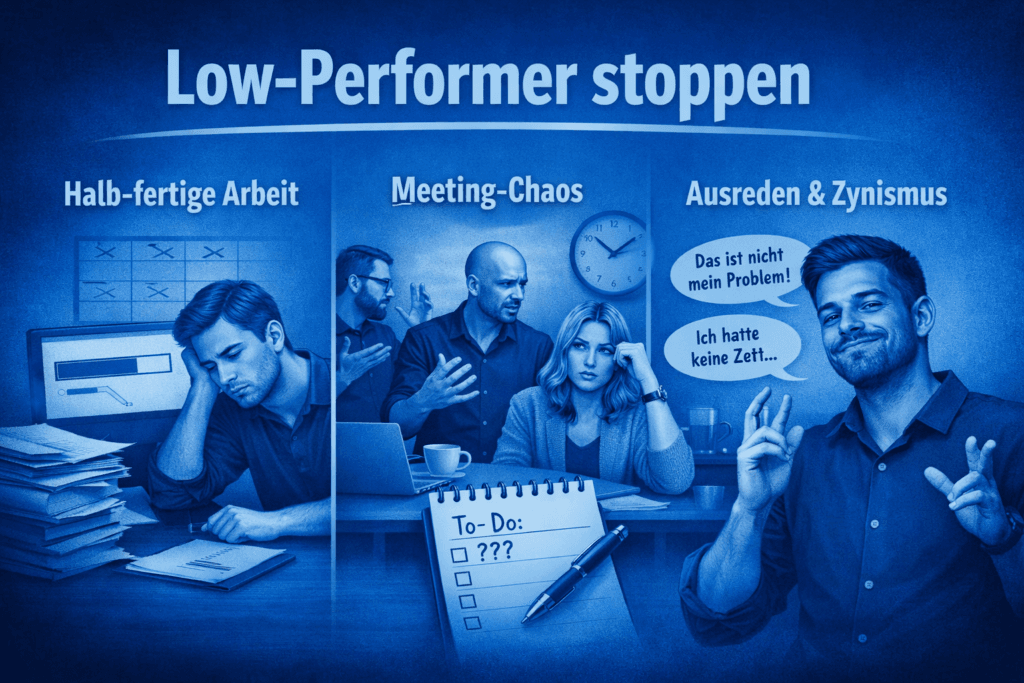
1.1. Tasks Are "Almost Done" – But Never Actually Finished
The classic. There's always "just one more small step" missing.
1.2. Deadlines Get Soft
Not once. Not twice. Regularly.
1.3. More Excuses Than Results
"I couldn't, because…" "That happened because…" "I thought we were doing it differently…"
1.4. Others Pick Up the Slack
Colleagues step in. You step in. The team carries the load.
1.5. No Initiative
Only the bare minimum gets done. No questions. No suggestions. No drive.
These patterns aren't "character." They're behavior that has crept in over time.
2. Why Low Performance Is Often a Leadership Problem
This is the uncomfortable part. But also the most important.
Low performance rarely happens because someone "doesn't want to." It happens because leadership:
- Doesn't spell out expectations clearly
- Doesn't hand off tasks cleanly
- Doesn't follow through on consequences
- Shows too much understanding
- Or hopes for too long that things will "sort themselves out"
Our success-blockers guide puts it this way:
"Leaders reinforce success-blocking patterns when they communicate unclearly, act inconsistently, or take on responsibility that isn't theirs to carry."
In other words: low performance is manageable. But only once you recognize the pattern.
3. The 3 Biggest Mistakes When Dealing With Low Performers
Mistake 1: Waiting Too Long
The longer you wait, the more entrenched the pattern becomes.
Mistake 2: Over-Explaining
Many bosses talk too much. Low performers listen politely — and carry on exactly as before.
Mistake 3: "Rescuing" Tasks
When you step in, you send a clear message: "You don't have to deliver — I'll take care of it."
That rewards exactly the wrong behavior.
4. How to Stop Low Performers – Calmly, Clearly, Effectively
Here's the part that will actually help you day to day.
4.1. Step 1: Name the Behavior – Without Judgment
Not: "You're unreliable."
Instead: "The last three deadlines weren't met."
Facts. No emotion.
4.2. Step 2: Describe the Impact
"As a result, the project is delayed and others have to step in."
This creates awareness.
4.3. Step 3: State the Expectation Clearly
"I expect you to reliably meet deadlines."
Short. Clear. No justification needed.
4.4. Step 4: Define the Consequence
Don't threaten. Be clear.
"If this doesn't work out, we'll redistribute the tasks."
That's leadership — not harshness.
This structure is a simplified version of the 4-sentence method, explained in detail in our success-blockers guide.
5. How to Hand Responsibility Back
Low performers have often learned: "If I don't deliver, someone else will."
You need to flip that.
Instead of explaining, ask:
- "What do you need to get this done reliably?"
- "What's your next step?"
- "By when can you commit to delivering this?"
This hands responsibility back — without applying pressure.
6. How to Avoid Drama
Low performers often respond with:
- Justification
- Emotion
- Deflection
- Blame-shifting
Your job:
- Don't get drawn in
- Don't argue
- Don't over-explain
Instead:
"I hear you. And the expectation still stands."
That's clarity. That's leadership. That's the MindOnDigital way.
7. When You Need to Set Boundaries
If nothing changes after 2–3 clear conversations, it's no longer a case of "can't."
It's a case of "won't."
And then you need:
- Clear consequences
- Clear roles
- Clear priorities
Our guide puts it this way:
"Low performers need to be contained in a way that protects the team, without excluding the person."
This is the point where leadership really shows its impact.
8. How the Success-Blockers Guide Can Help You
This article gives you an overview. The guide gives you:
- Concrete conversation scripts
- Typical patterns
- Clear examples
- A 4-sentence method
- 10 phrases you can use right away
- A self-check
- Guiding questions for employee conversations
- Case studies from mid-sized companies
It's your:
- Cheat sheet
- Frame of reference
- Prep tool
- Companion for difficult conversations
In short: it makes leadership easier, clearer, and calmer.
Conclusion: Stopping Low Performers Isn't an Art – It's Clarity
Low performance isn't a character flaw. It's a pattern. And patterns can be changed.
With:
- Clear expectations
- Calm conversations
- Consistent behavior
- And the right structure
leadership becomes easy again.
And that's exactly what the success-blockers guide is made for.
Further Guides & Resources
These resources go deeper into leadership without drama, helping you recognize patterns, create clarity, and hand responsibility back where it belongs.
Core Guide Pages
- Guides & Leadership – Clarity & Structure An overview of all guides, topics, and resources.
- Success Blockers – The Patterns That Hold Every Company Back The core system behind every pattern that blocks teams.
- Corporate Actors, PowerPoint Rangers & Bullshit Bingo – How Modern Companies Fail Through Show – Find out more about corporate actors, PowerPoint rangers, and bullshit bingo in our comprehensive show-culture guide.
Key Articles From Our Guide Series
- The 7 Success-Blocker Patterns
- Early Warning Signs of Team Chaos
- How Bosses Unconsciously Create Success Blockers
🧩 FAQ – Stopping Low Performers
❓ What actually counts as a low performer?
An employee who consistently stays below the agreed performance level — despite clear tasks, support, and the right conditions. Not "a bad day," but a pattern.
❓ Why do low-performance patterns develop?
Because expectations are unclear, leadership is inconsistent, or responsibilities are blurry. Low performance is rarely a personal problem — it's almost always a structural one.
❓ How do you stop low performance without escalating?
Through clear expectations, concrete examples, small steps, and consistent follow-up. Leadership means: clarity before harmony.
❓ What happens if you ignore low performance?
The engaged people burn out, the foot-draggers set the pace, and the team loses respect for leadership. Not acting is always more costly than acting.
Latest Posts
-

Fear of Change: The Silent Killer of Business Growth
Success avoidance at work is a common phenomenon, reinforced by fear of failure and unclear expectations. -

Poor Team Communication: The Main Cause of Failure
Poor Team Communication: The Main Cause of Failure Teams rarely fail due to lack of knowledge or motivation. They fail because of poor team communication working in the background — quiet, but relentless. Why teams fail – the invisible mechanisms that block performance. These mechanisms don't appear overnight. They grow out of routines, unspoken expectations, and structures that… <strong>Poor Team Communication: The Main Cause of Failure</strong> read more -

Setting Professional Boundaries: The Key to More Clarity and Efficiency
Setting professional boundaries for clarity and efficiency in the workplace. Learn to respect your own needs and avoid stress. -

An Overloaded Team: The Real Reason for Standstill
Overload & Chaos: The Silent Leadership Pattern That Paralyzes Every Team Many bosses see overload as a sign of dedication. In reality, it's often the visible symptom of leadership chaos. "Overload & Chaos – the silent leadership pattern that paralyzes teams." When everything matters at once, nothing is clearly prioritized, and everyone is "somehow busy," the result isn't… An Overloaded Team: The Real Reason for Standstill read more