Spotting Team Chaos Early: How to Read the Warning Signs
How to really tell that your team has already quietly hit the brakes internally — before spotting team chaos becomes a matter of damage control. It's not just a feeling; it's a clear indicator of deeper problems.
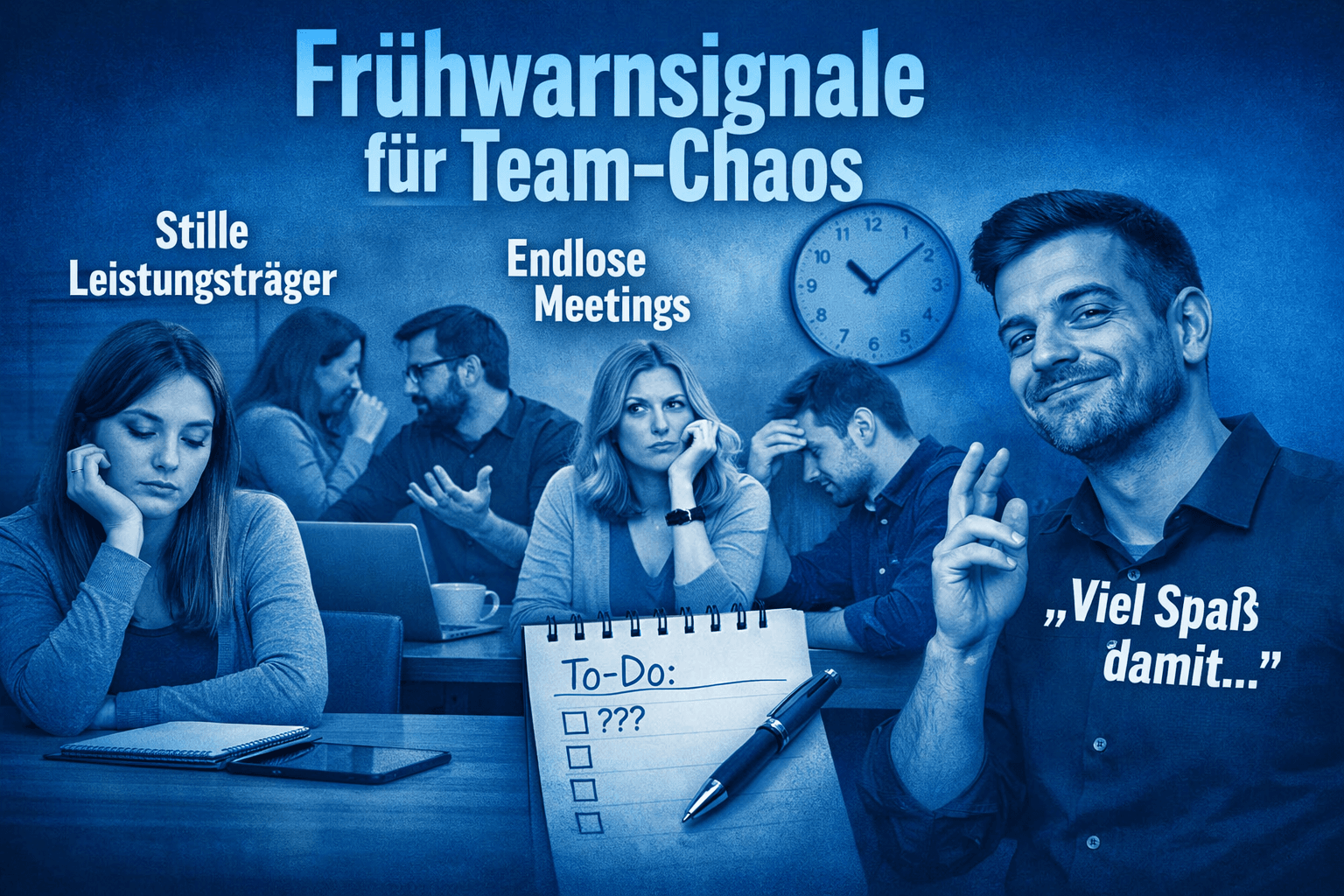
In hardly any company does chaos break out overnight. It builds up slowly — in meetings, in emails, in offhand remarks, in the looks people exchange. And that's exactly what makes it so dangerous: the warning signs are there, but nobody takes them seriously.
Many managers only notice something's wrong when:
- high performers start leaving
- conflicts escalate openly
- projects drag on and on
- or everyone "suddenly" seems overloaded
In reality, it was rarely sudden. The early warning signs had been there all along.
In this article, we'll take a close look at these signals — and how to spot them before your team slides into the red zone.
1. Meetings Where a Lot Gets Said, But Little Gets Decided
A classic early warning sign of team chaos: meetings after which nobody quite knows what happens next.
Typical signs:
- There's a lot of discussion but very few clear decisions
- Topics jump around from one to the next
- there's no clear division of tasks at the end
- the same points come up again week after week
What this triggers:
- the engaged people get worn out
- the quiet ones withdraw even further
- the cynics say: "It's not going to change anything anyway"
- and the team learns: "We talk, but we don't steer"
Early warning sign: if you often walk out of a meeting thinking, "Somehow we talked a lot but didn't really clarify anything," that's not a coincidence — it's a pattern.
Counter-move (without giving everything away):
- Every meeting needs a goal, a time limit, and ownership
- At the end: "Who's doing what by when?" — said out loud
- Deliberately flag recurring topics: "Why are we back here again?"
In the "Success Blockers" guide, you'll find concrete phrases for steering meetings calmly but clearly back on course — without any drama.
2. Quiet High Performers – When the Wrong People Go Silent
A very serious early warning sign: the wrong people go quiet.
Not the ones who always complain. The ones who usually:
- are constructive
- think along with the team
- take on responsibility
Signs:
- They speak up less often in meetings
- they comment less
- they "just do their job" — but without any visible energy
- they seem businesslike, but inwardly detached
What this means:
These are often the people already quietly asking themselves:
- "Do I even want this anymore?"
- "Is my effort even worth it?"
- "Are there other options out there?"
Early warning sign: when your best people stop pushing back, that's not a sign of harmony — it's a sign of withdrawal.
Counter-move:
- One-on-ones: "I've noticed you've gotten quieter — how are you really doing?"
- Give them space without pressure: listen, don't justify
- take it seriously, don't downplay it
In the guide, you'll find questions and conversation frameworks that help you prepare for talks like these — so you don't have to react purely on gut instinct.
3. Rising Office Gossip – More Sideways Remarks Than Straight Talk
Another early warning sign: important topics migrate out of official meetings and into unofficial spaces.
Typical patterns:
- "Officially" everything's fine — "unofficially," it's simmering
- Criticism doesn't surface in meetings, but by the coffee machine
- You hear more and more of "You can't say that openly here"
- Irony and jabs increase
What this reveals:
- There's a lack of trust in official channels
- People don't believe it's worth raising things openly
- Conflicts get postponed, not resolved
Early warning sign: if you learn more about your team from offhand comments, hints, or private conversations than from official meetings, that's a clear sign.
Counter-move:
- Deliberately ask in meetings: "What aren't we saying here that actually matters?"
- Don't punish criticism — structure it
- Make it clear: "Better said openly here than behind someone's back."
In the guide, you'll find typical "success-blocker phrases" that reveal your team is drifting into the rumor mill — along with suggestions for bringing the conversation back out into the open.
4. Tasks That Just "Somehow Never Get Done"
A very practical, but often overlooked, early warning sign: tasks everyone knows about — but nobody really drives forward.
Signs:
- To-dos show up in meeting notes over and over
- Deadlines get "slightly" missed — again and again
- Ownership is vague ("We'll take a look at that")
- in the end, whoever can't stand it anymore just does it themselves
What's behind it:
- Unclear ownership
- lack of priority
- hidden resistance ("I don't actually think this makes sense")
Early warning sign: if you have to bring up the same task multiple times without it actually moving forward, that's not a "time problem" — it's a structural or leadership problem.
Counter-move:
- Every task has one responsible owner
- Use clear wording: "You're responsible, others support you"
- Follow up without blame, but with clarity
In the guide, you'll find patterns for handing off responsibility cleanly — without pressure, but without sugarcoating it either.
5. Rising Irony and Cynicism
Humor is healthy. But: cynicism is an early warning sign.
Typical lines:
- "Sure, we'll definitely follow through on that…"
- "That's just another idea from up top."
- "We'll write it in the minutes, then it's done."
What this reveals:
- People don't feel taken seriously
- they've seen things get announced but never actually implemented
- they use irony to protect themselves from disappointment
Early warning sign: when irony becomes the default reaction to anything new, that signals a negative attitude toward leadership and decision-making.
Counter-move:
- Don't just smile cynicism away
- Address it calmly: "I'm hearing a lot of irony — what's behind that?"
- Be clear about what's realistic — and what isn't
In the guide, you'll find examples of how to handle cynical comments without slipping into self-justification or counterattack.
6. Constant Overload – But Unclear Priorities
Another early warning sign: everyone's "maxed out," but nobody can clearly say what actually has priority.
Signs:
- Everyone feels stressed
- Projects run in parallel
- there's barely any buffer
- "We don't have time" becomes the default phrase
What this reveals:
- Leadership isn't setting clear priorities
- the team is working in reactive mode
- strategic topics get left behind
Early warning sign: if you feel like your team is constantly running at the limit but still never really finishing anything, that's a structural issue — not an individual one.
Counter-move:
- Say it clearly: "This is more important than that, right now."
- Deliberately cut or postpone tasks
- don't just keep piling more on top
In the guide, you'll find frameworks for bringing clarity to the flood of tasks as a leader — without just applying "more pressure."
7. Nobody Talks About the "Why" Anymore
A quiet but very powerful early warning sign: the team only operates in "what" and "how" anymore — never in "why."
Signs:
- Tasks get worked through but no longer questioned
- there's barely any discussion left about purpose, direction, or goals
- people do the bare minimum required
What this reveals:
- inner distance
- loss of identification with the work
- leadership that's merely administrating instead of steering
Early warning sign: if you notice nobody asks "why" anymore, that's often a sign the team has already checked out internally.
Counter-move:
- Deliberately explain goals and the reasoning behind them
- Make room for questions
- don't interpret every question as resistance
In the guide, you'll find typical "success-blocker patterns" around purpose, direction, and clarity — and how to break them open without turning it into a show.
What You Can Do With These Early Warning Signs
The most important point: early warning signs aren't an accusation — they're a gift.
They show you:
- where your team really stands right now
- which patterns have crept in
- where you, as a leader, can step in
What matters isn't whether these signals show up. What matters is whether you recognize and take them seriously.
How the "Success Blockers" Guide Supports You Day to Day
The guide ["Success Blockers – The Patterns That Hold Every Company Back"] is deliberately built so you don't just read it once — you keep coming back to it.
You can use it as:
- An orientation tool: when you sense "something's off here" but can't quite put your finger on what. You'll find typical patterns and recognize: "That's exactly what's happening with us right now."
- A cheat sheet for meetings: a quick check before an important session: "What dynamics might come up today? How do I react if X or Y happens?"
- Preparation for employee conversations & one-on-ones: you no longer walk into conversations "blind," but with clear guiding questions, phrasing, and perspective.
- A reference guide for everyday leadership: "What do I do when…?" — and you'll find the matching pattern along with a concrete counter-move.
This article gives you an overview of early warning signs. The guide goes deeper, is more structured, and helps you turn signals into concrete leadership decisions.
Bottom Line: Team Chaos Announces Itself – If You're Watching
Team chaos is rarely a bolt from the blue. It announces itself through:
- meetings without decisions
- quiet high performers
- office gossip and cynicism
- tasks left undone
- constant stress without clear priorities
- missing discussion about the "why"
If you recognize and take these signals seriously, you can course-correct before performance and engagement collapse.
And that's exactly what the [Success Blockers guide] is for: a calm, clear companion, an orientation tool, cheat sheet, and preparation aid for your everyday leadership, your meetings, and your one-on-ones.
Related Guides & Resources
These resources dig deeper into leadership without the drama, helping you recognize patterns, create clarity, and hand responsibility back where it belongs.
Core Guide Pages
- Guides & Leadership – Clarity & Structure An overview of all guides, topics, and playbooks.
- Success Blockers – The Patterns That Hold Every Company Back The core system behind every pattern that blocks teams.
- Corporate Actors, PowerPoint Rangers & Buzzword Bingo – How Modern Companies Fail at Show – Find out more about corporate actors, PowerPoint rangers, and buzzword bingo in our complete guide to show culture.
Key Articles From Our Guide Series
- The 7 Success-Blocker Patterns
- Early Warning Signs of Team Chaos
- How Bosses Unknowingly Create Success Blockers
- How to Stop Low Performers
🧩 FAQ – Early Warning Signs of Team Chaos
❓ What are the first signs of team chaos?
Unclear ownership, constant misunderstandings, duplicated work, and tasks that "somehow" never get done. Chaos always starts quietly.
❓ Why does chaos happen in teams in the first place?
Because structure is missing. When priorities are unclear, decisions keep getting postponed, or leadership isn't visible, disorder follows automatically.
❓ How do I know if my team is overloaded?
When everything is urgent, deadlines keep slipping, conflicts go unspoken, and the most engaged people keep taking on more and more responsibility.
❓ How do you stop team chaos quickly and effectively?
Through clear priorities, visible tasks, real decisions, and regular short check-ins. Structure beats frantic activity.
Latest Posts
-

Fear of Change: The Silent Killer of Business Growth
Success avoidance in companies is a common phenomenon, made worse by fear of failure and unclear expectations. -

Poor Team Communication as the Main Cause of Failure
Poor Team Communication as the Main Cause of Failure Teams rarely fail because of missing knowledge or missing motivation. They fail because of poor team communication working quietly in the background — subtle, but relentless. Why Teams Fail – the invisible mechanisms that block performance. These mechanisms don't appear overnight. They grow out of routines, unspoken expectations, and structures that… <strong>Poor Team Communication as the Main Cause of Failure</strong> read more -

Setting Professional Boundaries: The Key to More Clarity and Efficiency
Setting professional boundaries is essential for clarity and efficiency at work. Learn to respect your own needs and avoid unnecessary stress. -

Overloaded Team: The Real Reason for Standstill
Overload & Chaos: The Silent Leadership Pattern That Paralyzes Every Team Many managers see overload as a sign of commitment. In reality, it's often the visible symptom of leadership chaos. "Overload & Chaos – the silent leadership pattern that paralyzes teams." When everything is important at once, nothing is clearly prioritized, and everyone is "somehow busy," nothing… Overloaded Team: The Real Reason for Standstill read more